
top of page

News Articles

September 23, 2021; Tishrei 17, 5782

Halacha – Jewish Law A Software’s Trial Period

Question: If a developer provides software that can be downloaded from the internet for a free evaluation period of let’s say 30 days, after which the developer says the software must be bought or deleted, how strictly must one abide by this provision?

Rabbi Yisroel Belsky ZT”L responds: If the consumer needs more time for the evaluation period, I am certain the developer will not mind if the consumer

keeps it for an extra few days past the 30-day evaluation period, assuming the potential customer is still genuinely evaluating it.

If the 30-day evaluation period has expired and the consumer is no longer

evaluating it, he must abide by the developer’s provision and either

purchase or delete the software. When a person takes something that is

meant for evaluation only and then keeps it, it is, as Rav Moshe Feinstein

ZT”L says, genuine theft*. I always tell people that no success will come

from something a person takes - a book, or anything else - that a person

should purchase, but instead figures a way to obtain it without paying for

it. Typically, the justification that I hear is that the consumer wants to use

it for some “grand purpose”. However, what value does the grand purpose

serve if it was achieved through theft?
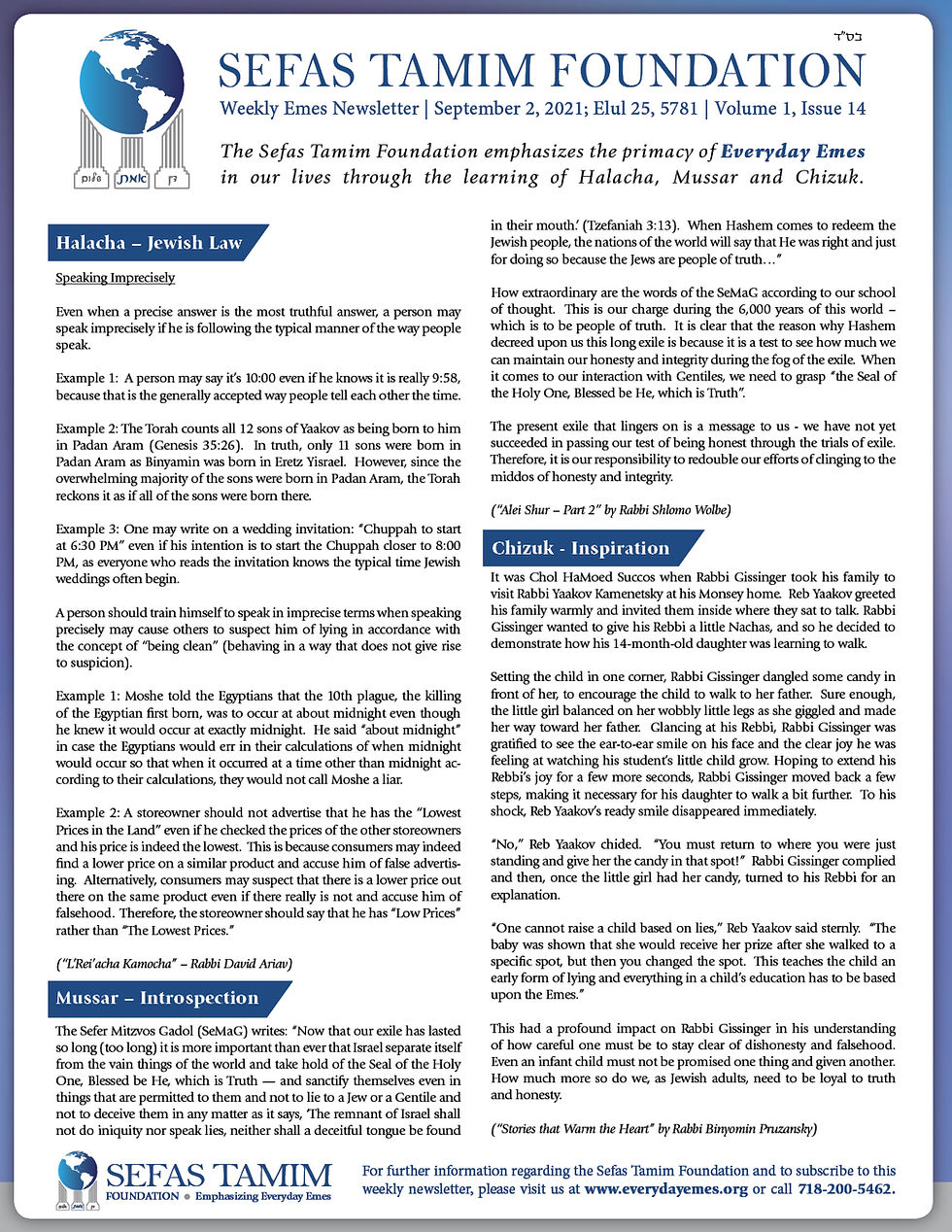


September 2, 2021; Elul 25, 5781

Halacha – Jewish Law Speaking Imprecisely

Even when a precise answer is the most truthful answer, a person may speak imprecisely if he is following the typical manner of the way people speak.

Example 1: A person may say it’s 10:00 even if he knows it is really 9:58, because that is the generally accepted way people tell each other the time.

Example 2: The Torah counts all 12 sons of Yaakov as being born to him in Padan Aram (Genesis 35:26). In truth, only 11 sons were born in Padan Aram as Binyamin was born in Eretz Yisrael. However, since the

overwhelming majority of the sons were born in Padan Aram, the Torah

reckons it as if all of the sons were born there.


August 12, 2021; Elul 4, 5781

Halacha – Jewish Law Offering a Kindness That is Sure to be Declined: The Gemara (Chullin 94a) prohibits one to offer a kindness to someone if one knows the offer will be declined. The Gemara cites the following examples. A person should not urge another individual to join him for a meal when he knows that the invitee will not accept the invitation. A person should not offer another individual a gift when he knows that the gift will not be accepted. These offers are prohibited because they are a form of deception (Genaivas Daas) and create a mistaken impression that will evoke undeserved goodwill in return.


Other contemporary examples include offering an acquaintance a ride when one knows that the individual already has a ride, offering a neighbor cleaning help when one knows that the neighbor already has cleaning help and offering a colleague help with a task when one is aware that someone else is already providing the needed assistance.


ABOUT US >

The Sefas Tamim Foundation emphasizes the primacy of Everyday Emes in our everyday lives through educational and inspirational program study of Halacha, Mussar and Chizuk.

Subscribe to our Parsha Sheet

CONTACT >

T: 718-200-5462

E: info@everydayemes.org

© 2026 by Sefas Tamim Foundation
Designed by GildenDesigns.com

bottom of page